This is the training copy of Ambro Metals Ltd. Every customer, product and number in it is made up, so press anything. It resets itself after an hour with nobody in it. The real books live at ambrometals.rightweb.app, and nothing you do here reaches them.

Learn Ambro Metals in six sessions

Six sessions of 30 to 45 minutes on the Metals training copy: Leo's pages, the projects pipeline with architects, kilo rates, selling, buying from Europe, and the month-end check. Your ticks save here, under your name, so you can pick up on any device.

Who is training?

Type your name to start your own path, or resume with the code you were given.

The team

Everyone's path, one row each. Names and counts only.

Nobody has started yet. Be the first.

Pick a name above to turn on the tick boxes. You can read everything without one.

Session 1 · Get in and look around0/20 steps

30 minutesLog in as Mia (the owner) · No typing today
Today's goal: know what this training copy is, find Leo's pages, and see the one idea everything hangs on.

The one idea (5 min)

The system keeps one list of everything that happened in the company. We call it the tape. A sale, a delivery, a payment: each is one line, and lines are never rubbed out. Every page you will see is a print of that list, worked out the moment you look.

This is the training copy

Every customer, product and number here is made up, so press anything. Nothing you do reaches Ambro's real books. The copy starts fresh by itself after an hour with nobody in it.

1.1 Log in as the owner5 min
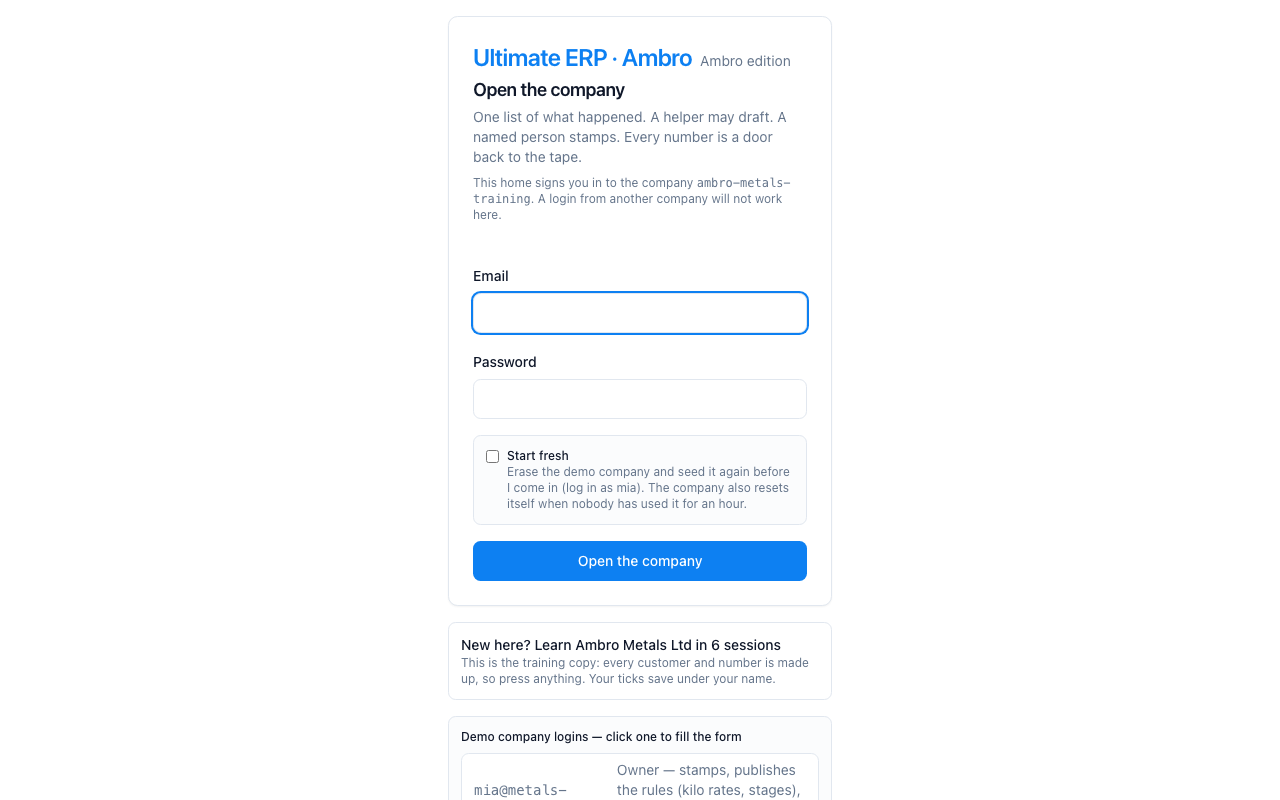
The login page. Each practice person is a button that fills the form.
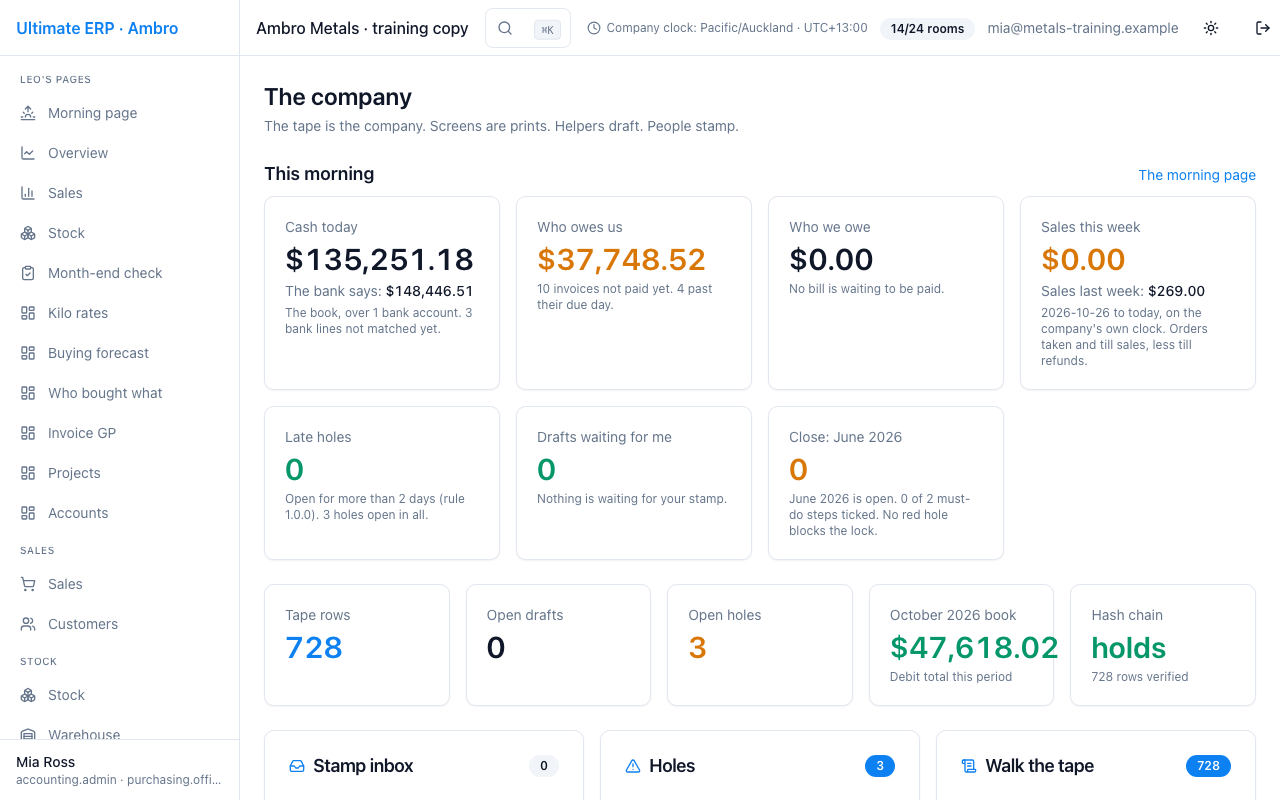
You should see: a page called The company, with cards across the top: Cash today, Who owes us, Who we owe, Sales this week.
Why it matters: Mia is the owner. She stamps, publishes the rules (kilo rates, project stages) and locks months. Most of today you are Mia.

1.2 Read the home page8 min

The company. Cards across the top; every number opens its rows.
You should see: a Close card for the oldest open month, and Tape rows counting every line.
Why it matters: every number is a door to the lines behind it. Nothing on a page is typed in by hand.

1.3 Leo's pages in the menu7 min

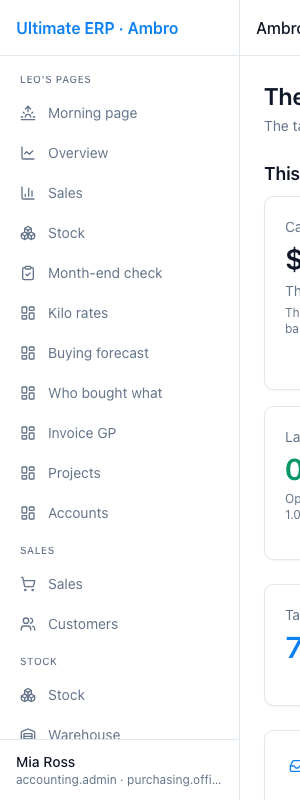
Leo's pages at the top of the menu.
You should see: Leo's pages first, then the rooms where work is done.
Why it matters: Leo's pages answer the questions Leo asked in the 20 October meeting. The other groups are where people work.

1.4 The rooms Leo shut5 min

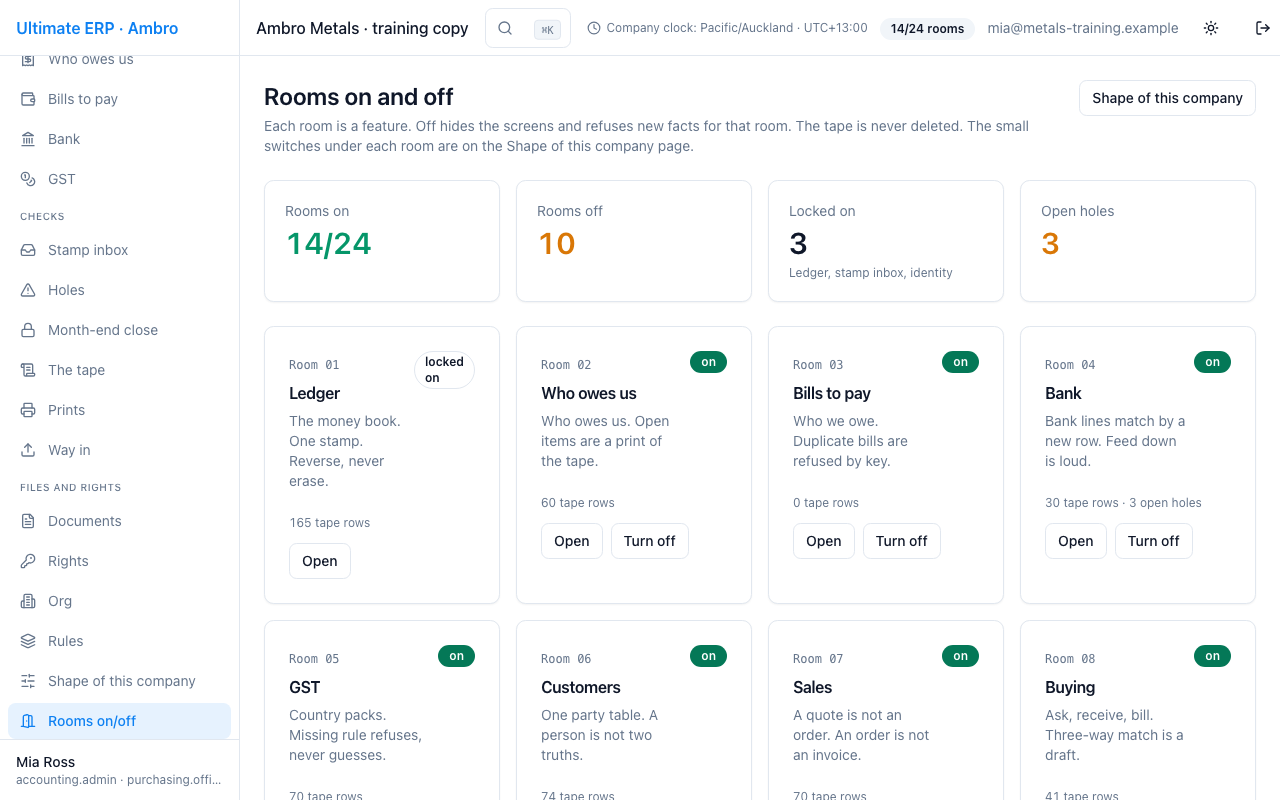
Rooms on and off. Ambro runs 14 of the 24 rooms.
You should see: ten rooms off, and three that say locked on: Ledger, Rules, Identity and org.
Why it matters: a room that is off hides its screens and refuses new rows. The tape keeps everything.

1.5 Drill: the guest sees nothing5 minrefusal drill

Do the wrong thing on purpose. Read the refusal, and write down the words it used.

You should see: This door is closed. This login carries no data.
Why it matters: a login is a key. A key with no role opens nothing, so nobody sees the books by accident.

Check yourself

What is the tape?
One list of everything that happened. Lines are never rubbed out. Every page is a print of it.
Why does Who we owe say nought?
Ambro keeps its supplier bills in Xero. This system does not hold them yet, on the real home too.
Can you break anything in the training copy?
No. It is made up, it reaches no real books, and it starts fresh after an hour of quiet.

Session 2 · Read the business: Leo's pages0/19 steps

35 minutesLog in as Mia, then Grace (the accountant)
Today's goal: read sales, margin, stock and invoices the way Leo does, and open the lines behind any number.

Leo's pages are prints. Nobody types into them. They read the tape and add it up the moment you look. Each number is a link to the lines behind it.

2.1 Overview: this month and last8 min
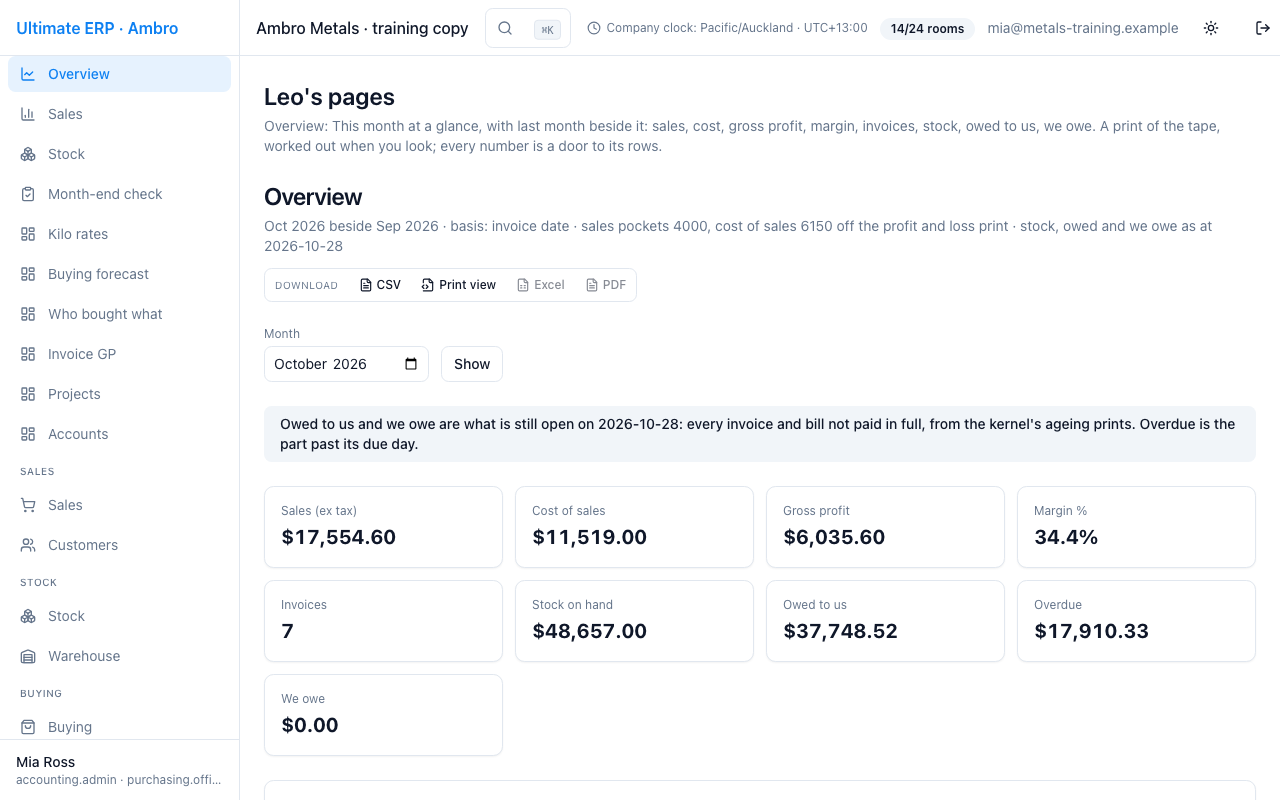
Overview: this month beside last, every number a door.
You should see: a line under the title that names both months and says basis: invoice date.
Why it matters: a month you can trust starts with the same few numbers every time, read the same way.

2.2 Sales by brand, customer and rep8 min
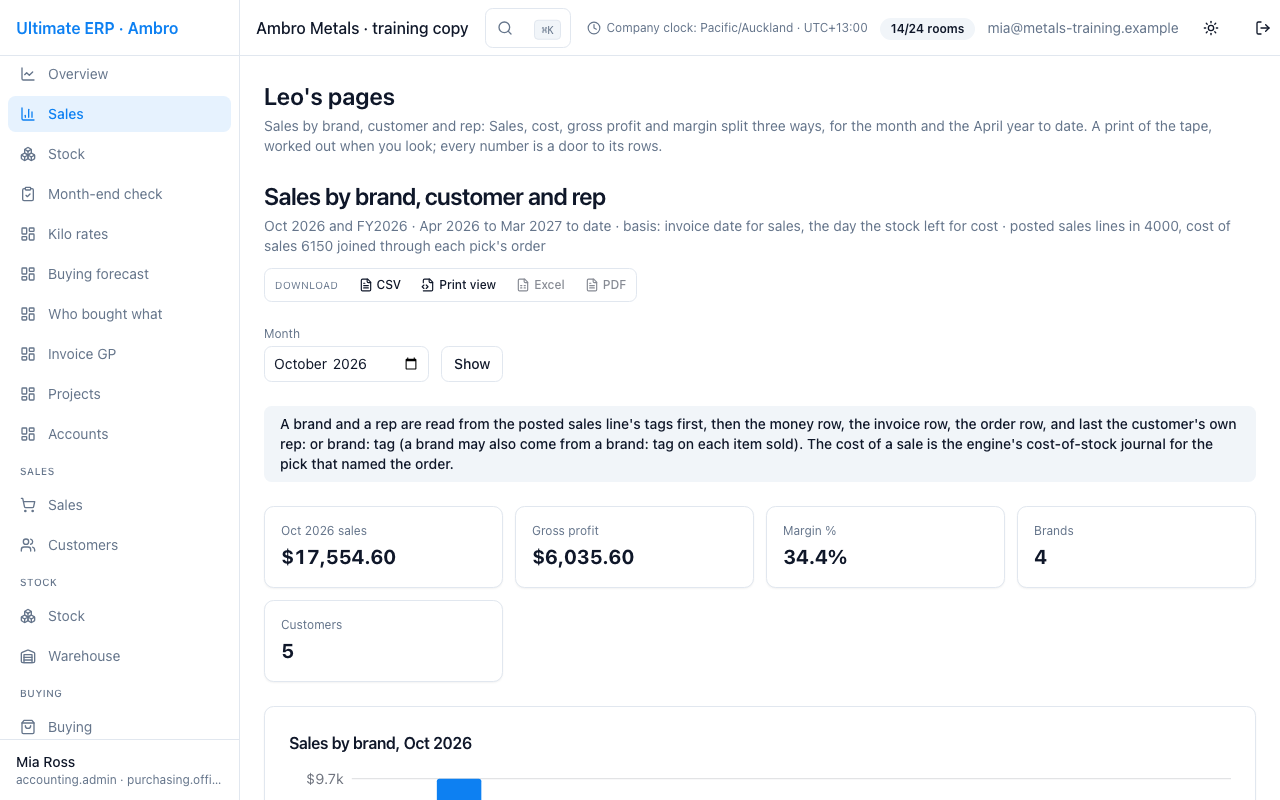
Sales split three ways: brand, customer, rep.
You should see: brands such as copper sheet, pre-patinated, bronze, brass and accessories.
Why it matters: a brand is the item's Unleashed product group. A rep is the customer's rep. Leo asked for both splits.

2.3 Stock cover6 min

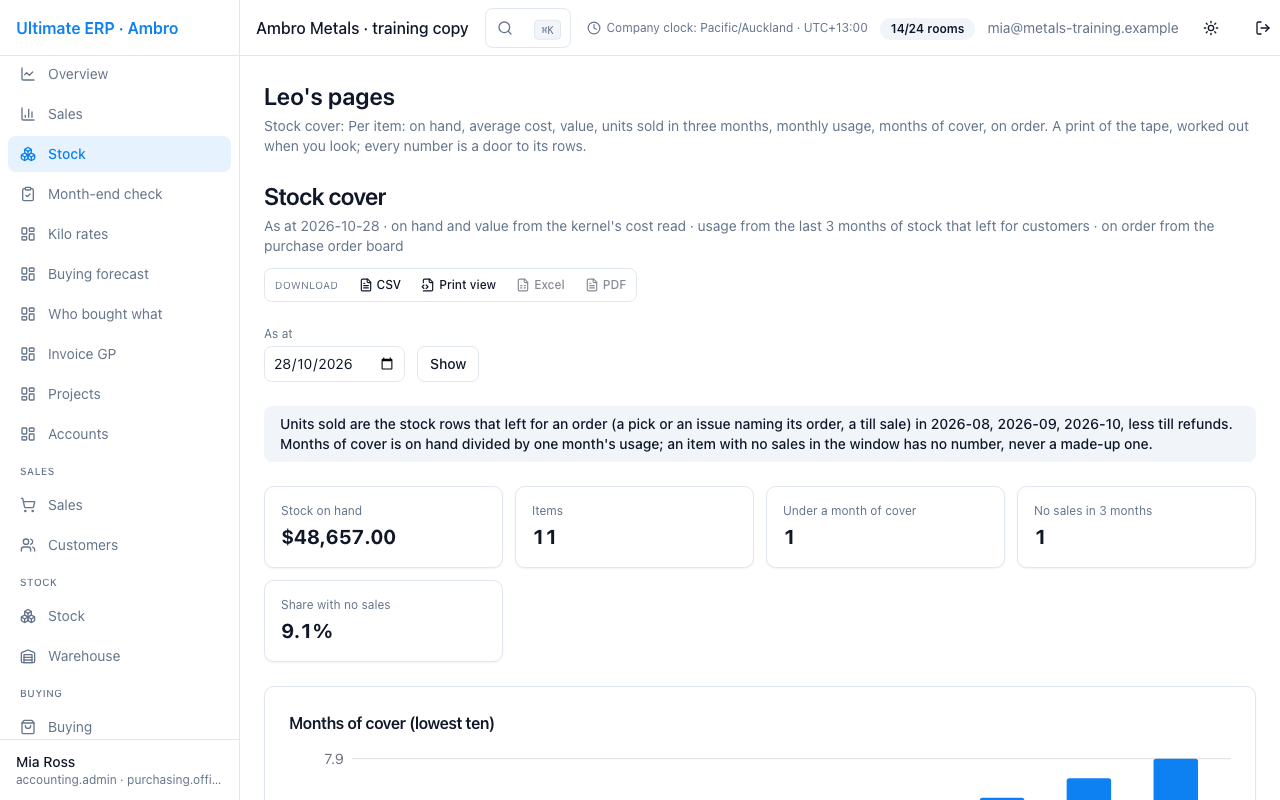
Stock cover, lowest first.
You should see: an item with stock on its way from Europe shows it under On order.
Why it matters: cover is what is on the shelf divided by one month's sales. Low cover with nothing on order is a call to the mill.

2.4 Invoice GP and Who bought what8 min
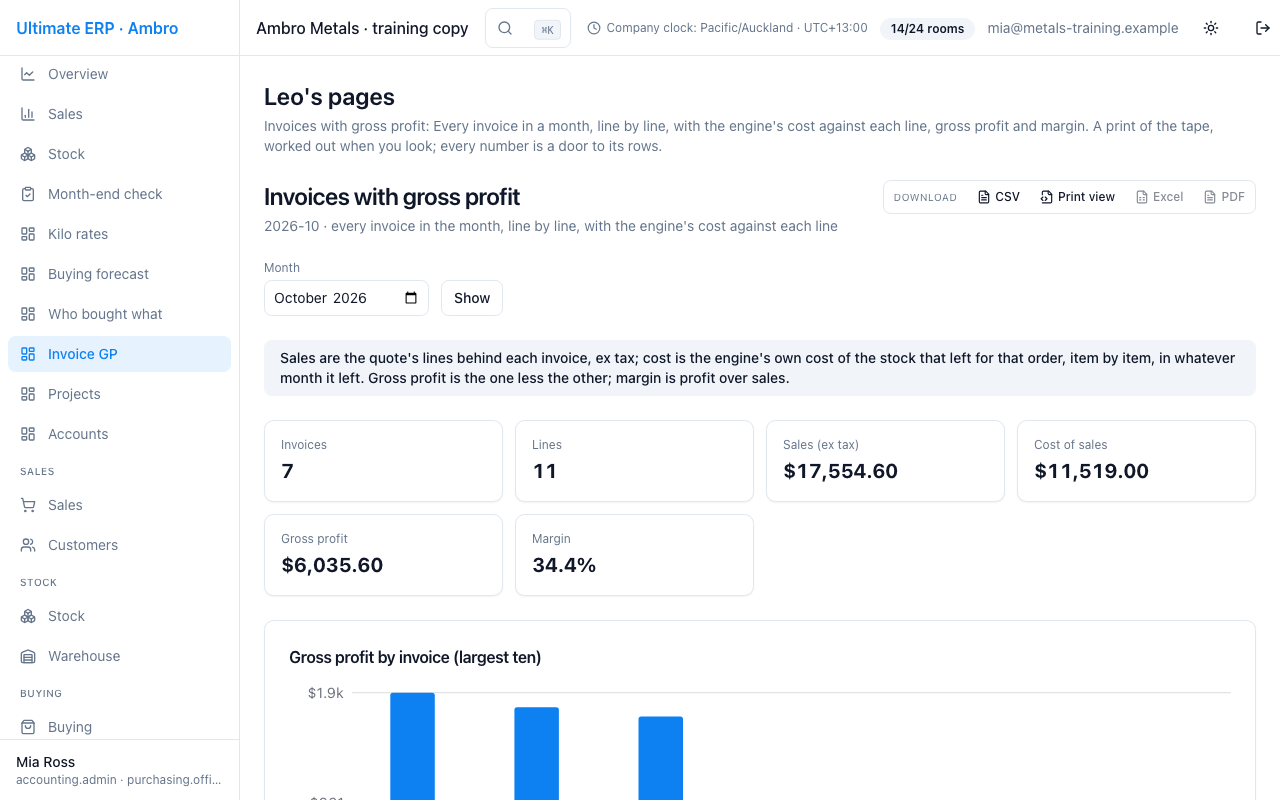
Every invoice line with its own cost and margin.
You should see: one item, every customer it went to in the last year, with units and the last day.
Why it matters: the margin on each line is the number Leo could not see in Unleashed.

2.5 Drill: the accountant reads but cannot press5 minrefusal drill

Do the wrong thing on purpose. Read the refusal, and write down the words it used.

You should see: on Projects, Grace sees the board and the Show button, but no Open, Move, Link or Close forms.
Why it matters: the accountant can check everything without changing anything.

Check yourself

Where does a brand come from?
The item's Unleashed product group, kept as a brand tag on the item.
What does 'every number is a door' mean?
Click a number and the tape lines behind it open.
Which login reads everything and stamps nothing?
Grace, the accountant.

Session 3 · Projects: the architect's pipeline0/24 steps

40 minutesLog in as Ella (sales), then Mia
Today's goal: follow an architectural job from the first chat to the order: the people on it, what you showed them, and the next step.

On the Metals side a job starts long before anyone orders. The architect or designer specifies. The roofer, cladder or fit-out contractor at the end orders. A project holds it all: the stage, the people by role, what you showed them (six things at most) and the next step with a date.

Leo's stages are: talking, specified, sampled, quoted, ordered, delivered.

3.1 Read the board6 min
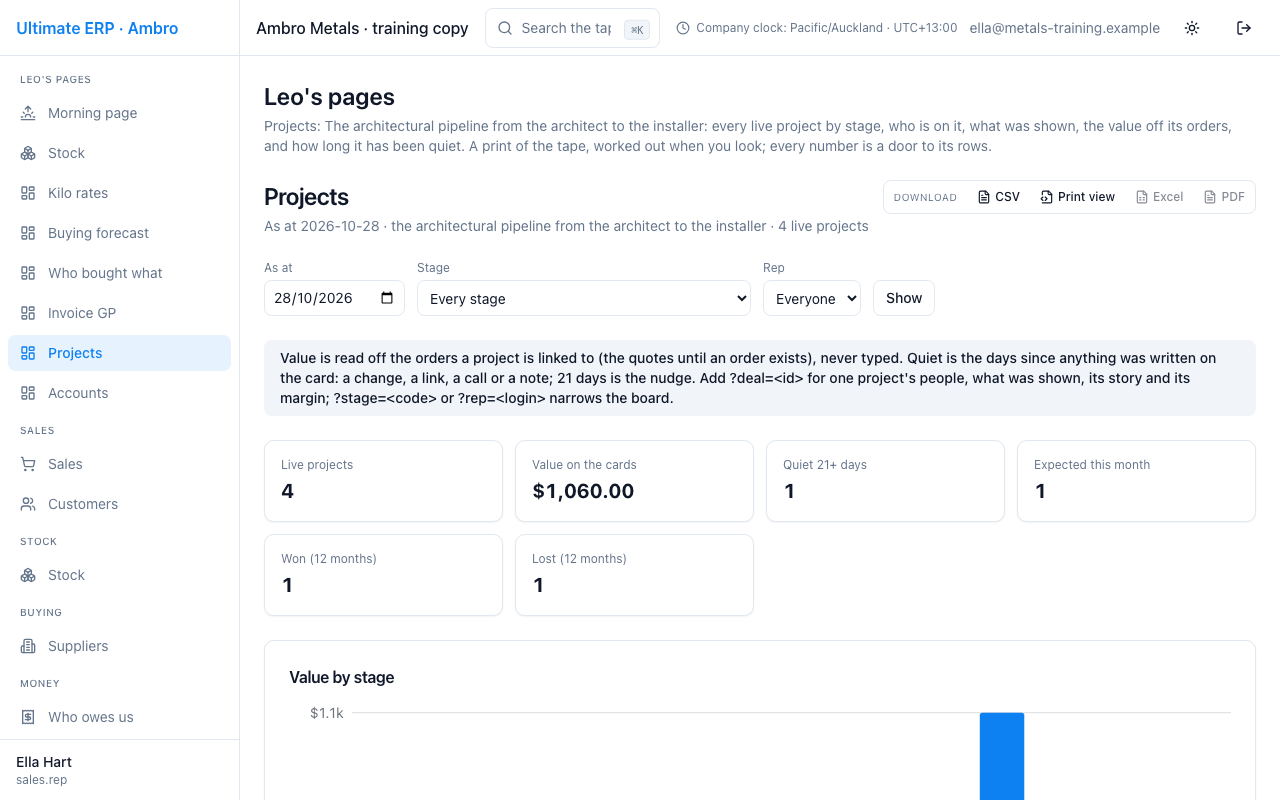
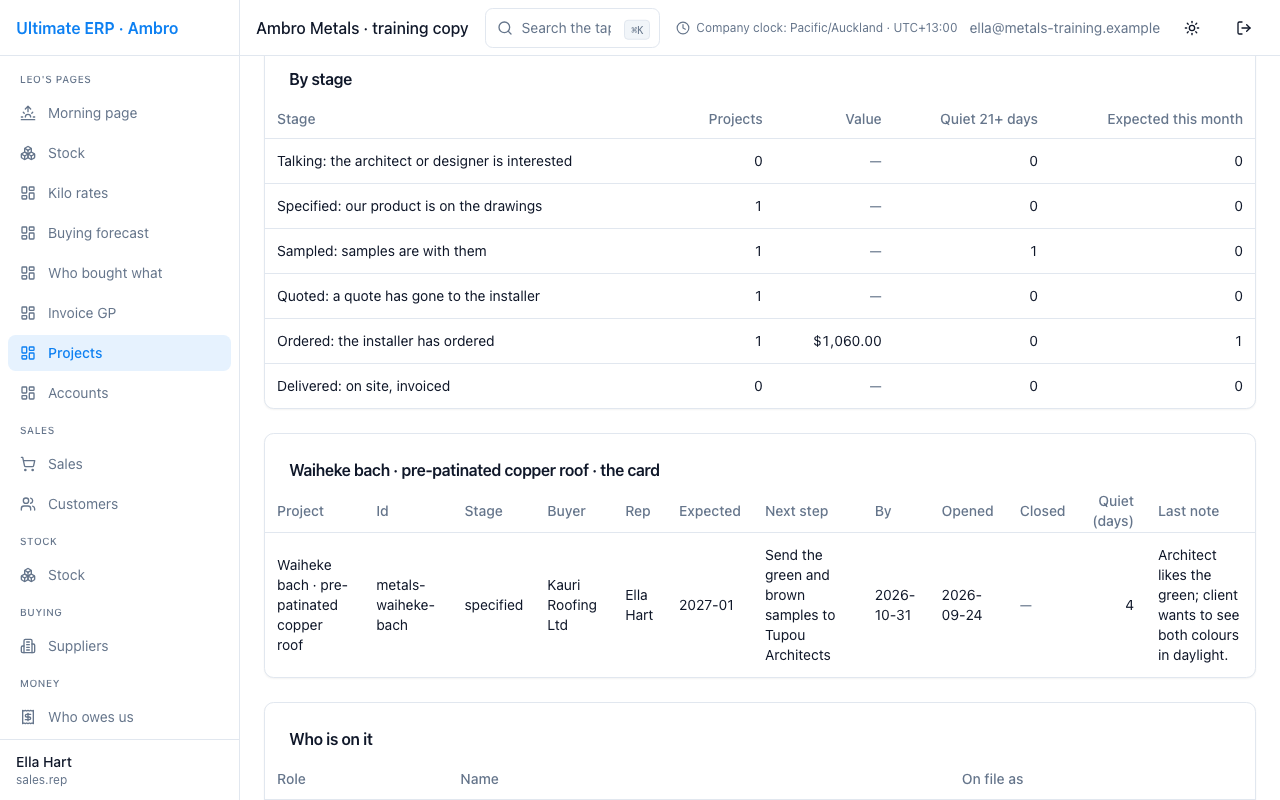
The projects board: stage, people, value, quiet days.
You should see: every live project by stage, the quietest first.
Why it matters: a project nobody touched for three weeks is a job about to be lost.

3.2 One project's card6 min

One project: the card, the people, what was shown, the story.
You should see: the next step: Send the green and brown samples to Tupou Architects.
Why it matters: anyone can pick up a project and know what to do next.

3.3 Open your own project10 min

You should see: done, and your project on the board under Talking.
Why it matters: a project is a line on the tape, so nobody can lose it.

3.4 Drill: a seventh thing shown5 minrefusal drill

Do the wrong thing on purpose. Read the refusal, and write down the words it used.

You should see: seven products shown is more than six: Leo's rule, never show them more than six things at once.
Why it matters: the rule lives in the system, so a new salesperson learns it the first time.

3.5 Move it along, and write down a call8 min

You should see: your project under Specified with its quiet days back to 0.
Why it matters: every change and every call is on the tape, with who and when.

3.6 Link the order, and close a project5 min

You should see: a value on Ponsonby townhouses, read from the order, and your project under Closed in the last 12 months.
Why it matters: a project's value comes from real orders, never typed. A closed project keeps its story and its reason.

Check yourself

Who orders on an architectural job?
The roofer, cladder or fit-out contractor at the end. The architect specifies.
How many things may you show a client at once?
Six. A seventh is refused by name.
Where does a project's value come from?
From the orders linked to it, read live.

Session 4 · Price by the kilo, then sell0/20 steps

45 minutesLog in as Ella, then Tama, then Raj
Today's goal: quote a kilo customer at rate times weight, take the order, pick it, and invoice it with a second pair of hands.

Some customers buy by the kilo. They hold one rate a kilogram, and each item has a weight. The price is rate × weight, worked out, never guessed.

A sale takes three people: sales quotes and orders, the warehouse picks, accounts invoices. Nobody does all of it.

4.1 Read Kilo rates6 min
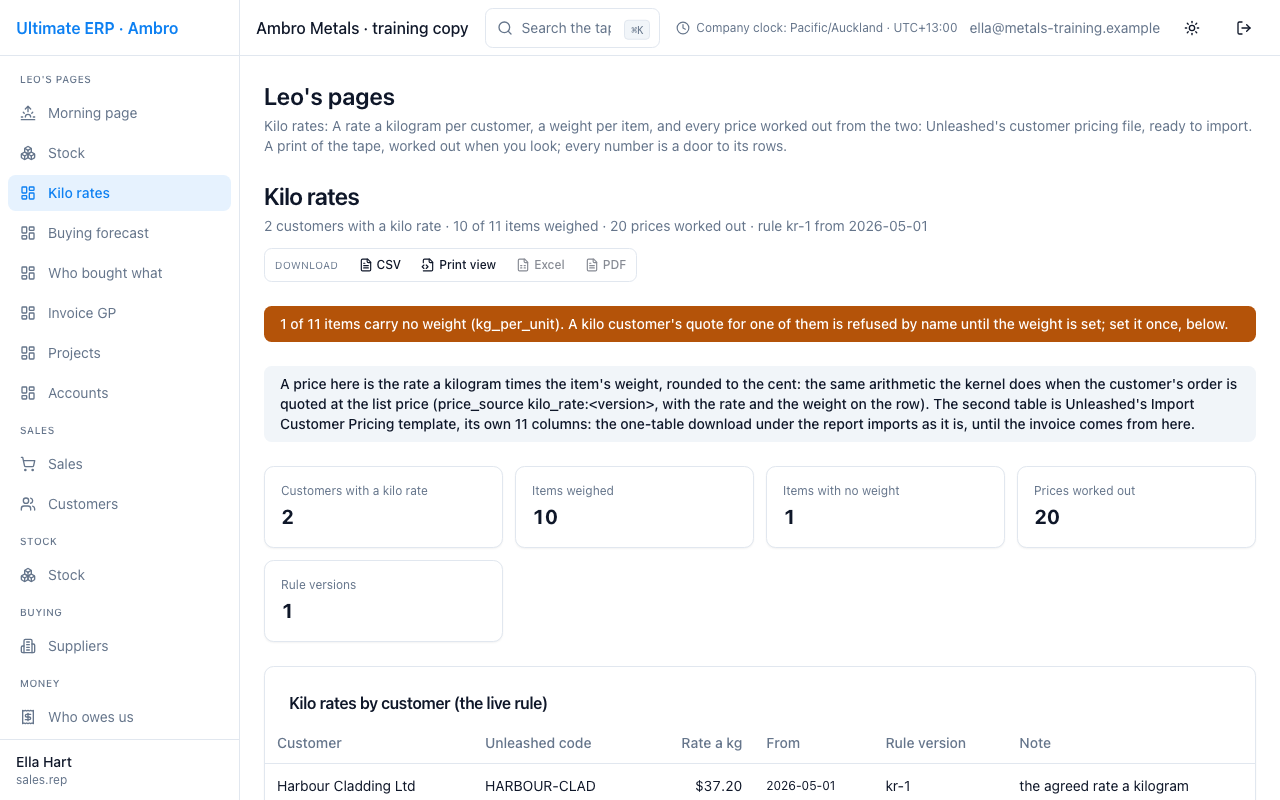
Kilo rates: the rate, the weight, the price worked out.
You should see: every price laid out in Unleashed's own Customer Pricing columns, ready to download.
Why it matters: one number per customer, and every price follows. Change the rate and every price moves.

4.2 Drill, then a quote at the kilo price10 min
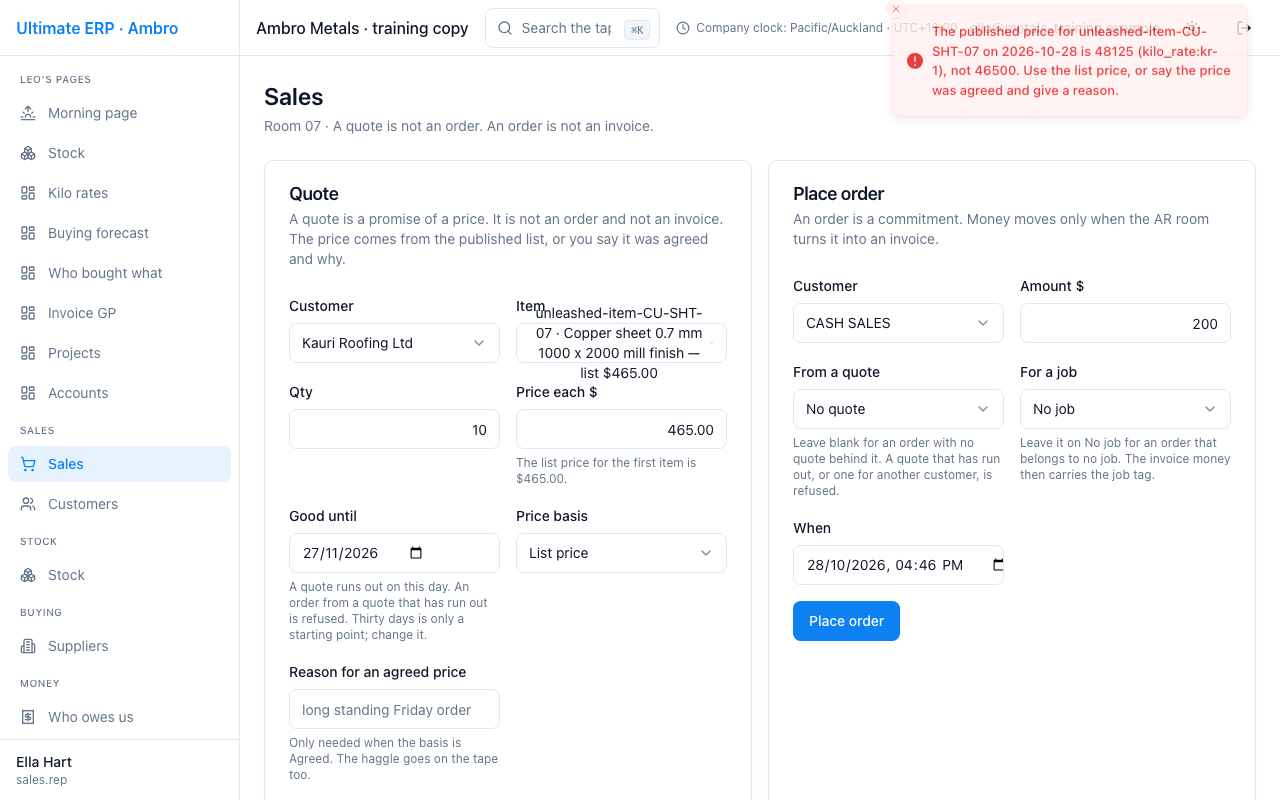
The quote refused, naming the kilo price.
You should see: the second quote lands at $481.25 a sheet: rate × weight.
Why it matters: a person cannot quote a kilo customer the wrong list by mistake. The refusal names the right price.

4.3 Drill: freight for a kilo customer6 minrefusal drill

Do the wrong thing on purpose. Read the refusal, and write down the words it used.

You should see: the agreed freight lands: a price a person agreed needs no weight.
Why it matters: the system never makes up a price. A person agrees one and says why, and that is on the tape.

4.4 Place the order5 min

You should see: done, and the order on the Order board.
Why it matters: a quote is a promise. An order is a yes. Both stay on the tape and point at each other.

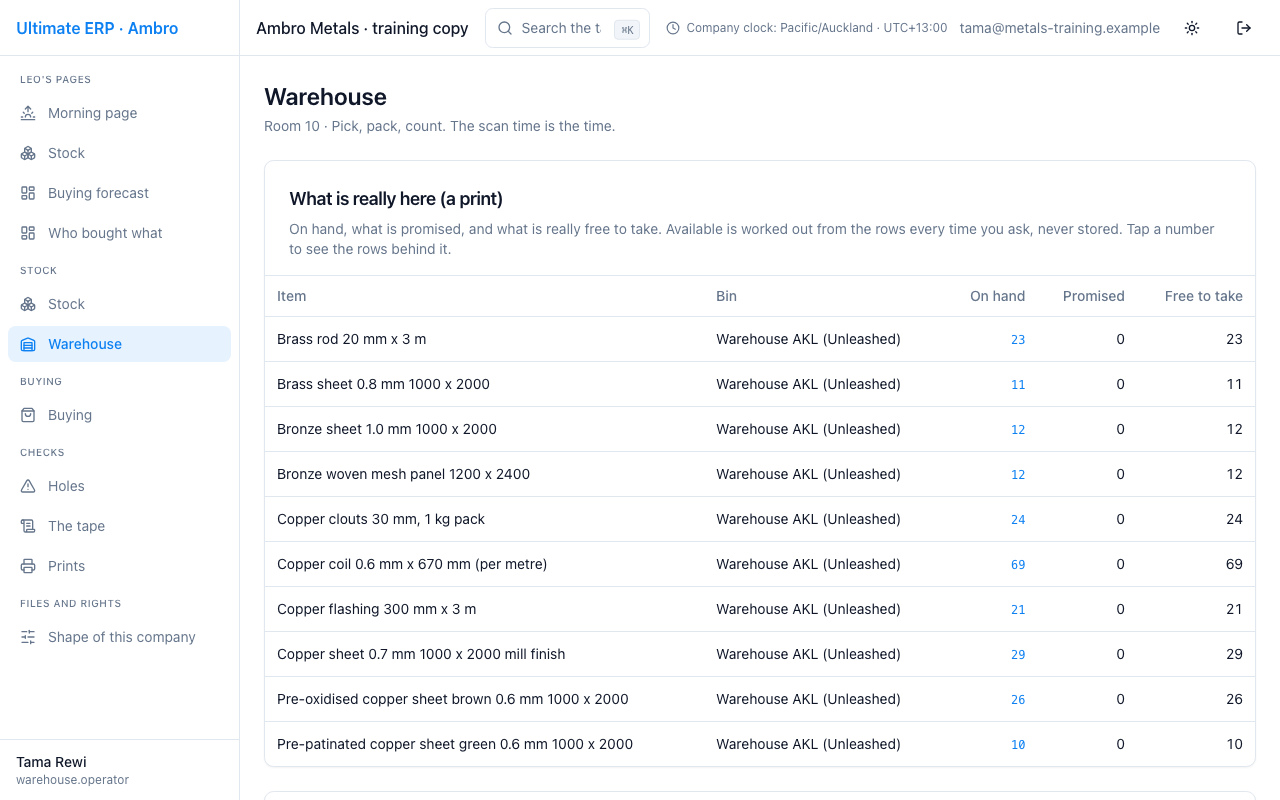
4.5 Pick it, and a short pick8 min

The warehouse: what is really here, and the Pick form.
You should see: on hand for the copper sheet ten lower, and one short waiting to be chased.
Why it matters: a pick names its order. That is how each sale gets its real cost on Invoice GP.

4.6 Invoice it, as a second person6 min

You should see: a new invoice for Kauri Roofing, and its margin on Invoice GP.
Why it matters: the person who sold is not the person who invoices: two pairs of hands on every sale.

Check yourself

What is a kilo price?
The customer's rate a kilogram times the item's weight.
What happens to a freight line for a kilo customer?
At the list price it is refused (no weight). At an agreed price with a reason it lands.
Who invoices an order?
Accounts (Raj), not the person who sold it.

Session 5 · Buy from Europe0/15 steps

40 minutesLog in as Mia, then Tama
Today's goal: know when to order from the mill, raise an order in euros, and take the container in.

Ambro's metal comes from Europe and a container takes months. The Buying forecast says when the next order must go. An order to the mill is in euros. The system turns euros into dollars at the published rate on the day, and never guesses a rate.

5.1 The buying forecast8 min
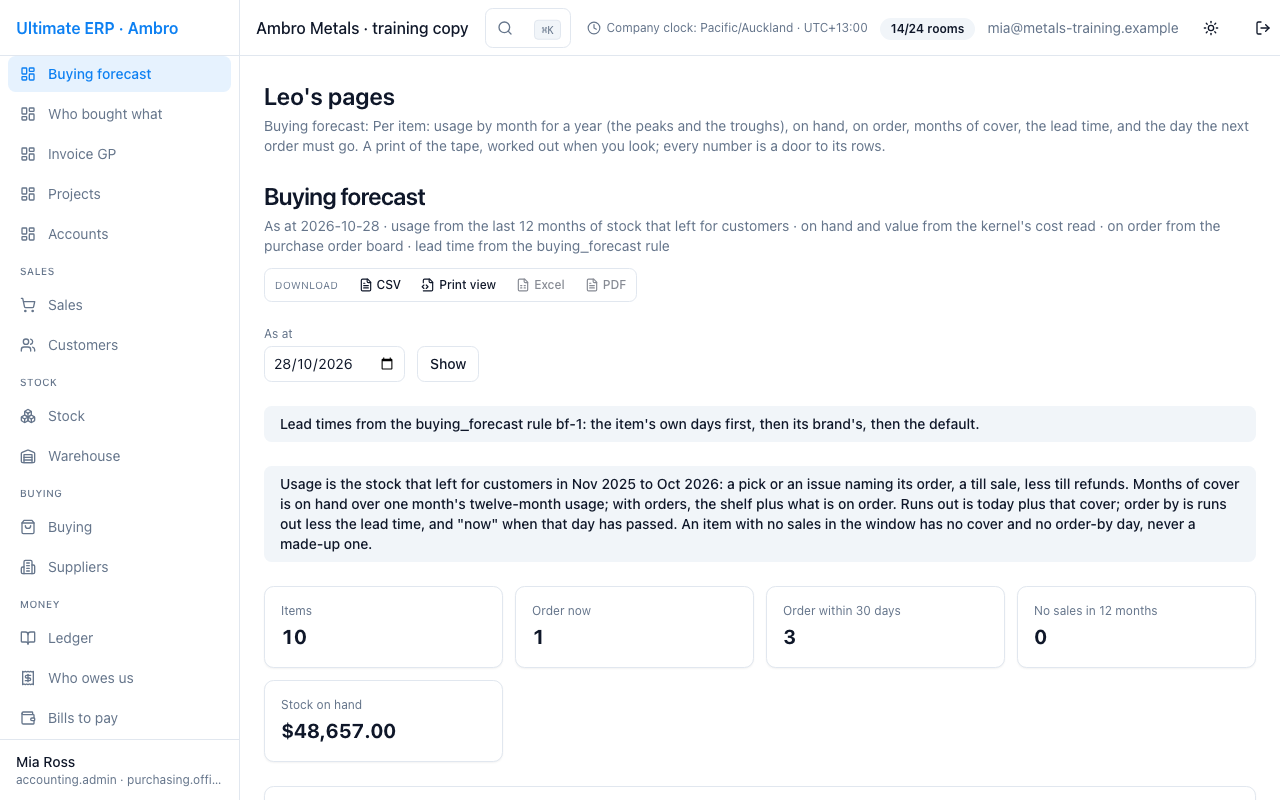
The buying forecast: when the next order must go.
You should see: per item: sales each month, on hand, on order, months of cover, the day it runs out and the day to order by.
Why it matters: the container must land before the shelf runs dry.

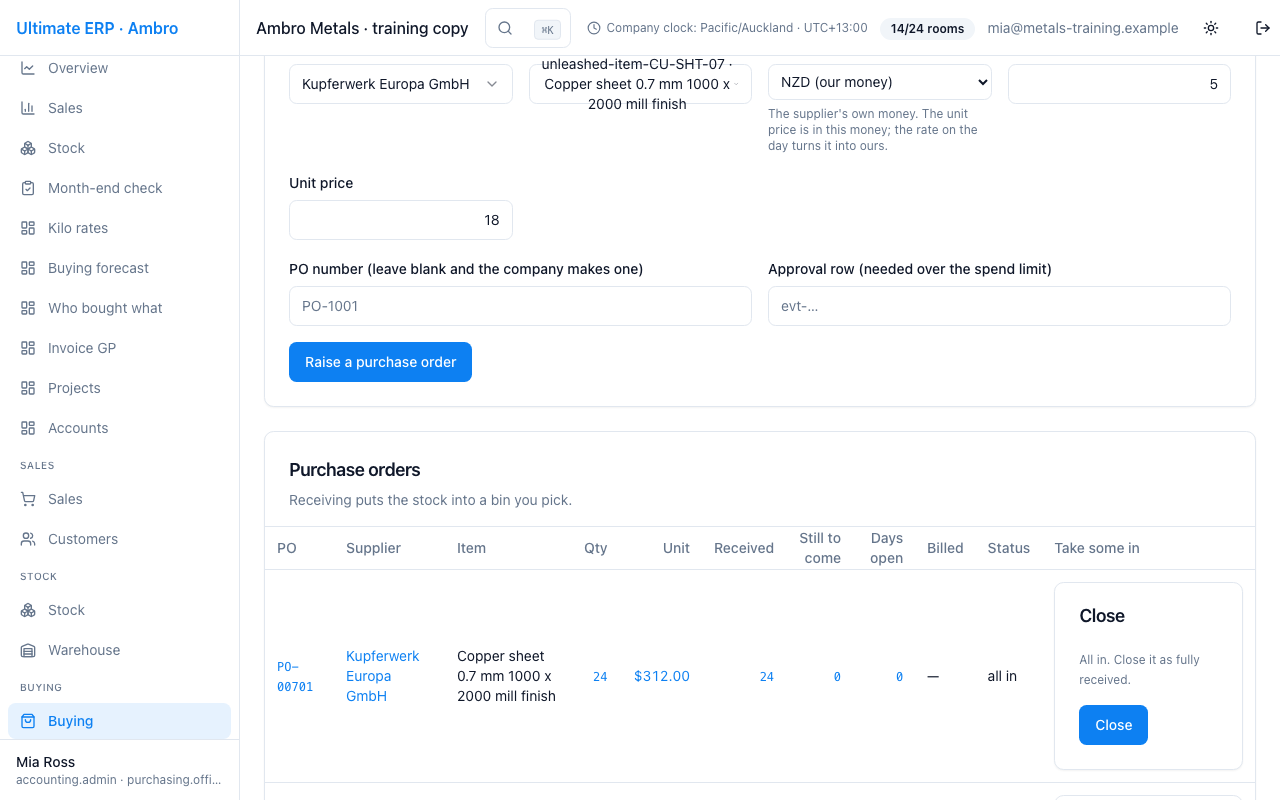
5.2 The euro order on the water5 min

Purchase orders: the euro order still to come.
You should see: two lines with stock still to come, status open.
Why it matters: the mill bills in euros, so the order stays in euros.

5.3 Raise a euro order8 min

You should see: a new open order reading EUR 180.00 a sheet.
Why it matters: the rate is read when the stock arrives, from the published rate sheet, never guessed.

5.4 Drill: a money with no rate5 minrefusal drill

Do the wrong thing on purpose. Read the refusal, and write down the words it used.

You should see: Refused, not guessed. Nothing landed.
Why it matters: a pound order waits until somebody publishes a pound rate. A made-up rate would be a number somebody later believes.

5.5 Take the container in8 min

You should see: the order line says all in, and Stock cover shows the new sheets.
Why it matters: stock is in when the warehouse says so, on the day it arrived.

Check yourself

What does the Buying forecast's order-by day mean?
The last day to order so the container lands before the shelf runs out.
What turns euros into dollars?
The published rate on the day. A money with no rate is refused.
Who takes a container in?
The warehouse (Tama).

Session 6 · Month-end: can we trust it?0/20 steps

45 minutesLog in as Raj, then Mia, then Tama
Today's goal: match the bank, read the month-end check against Xero, and close a month with two names.

A month is done when the bank is matched, the numbers agree with Xero, and two people have signed: one prepares, a different one reviews. Then it locks, and nothing new can land in it.

Months lock oldest first.

6.1 Match last week's payments8 min

You should see: Who owes us lower by what was paid, and no unmatched bank line left.
Why it matters: money in is only real when it is matched to the invoice it pays.

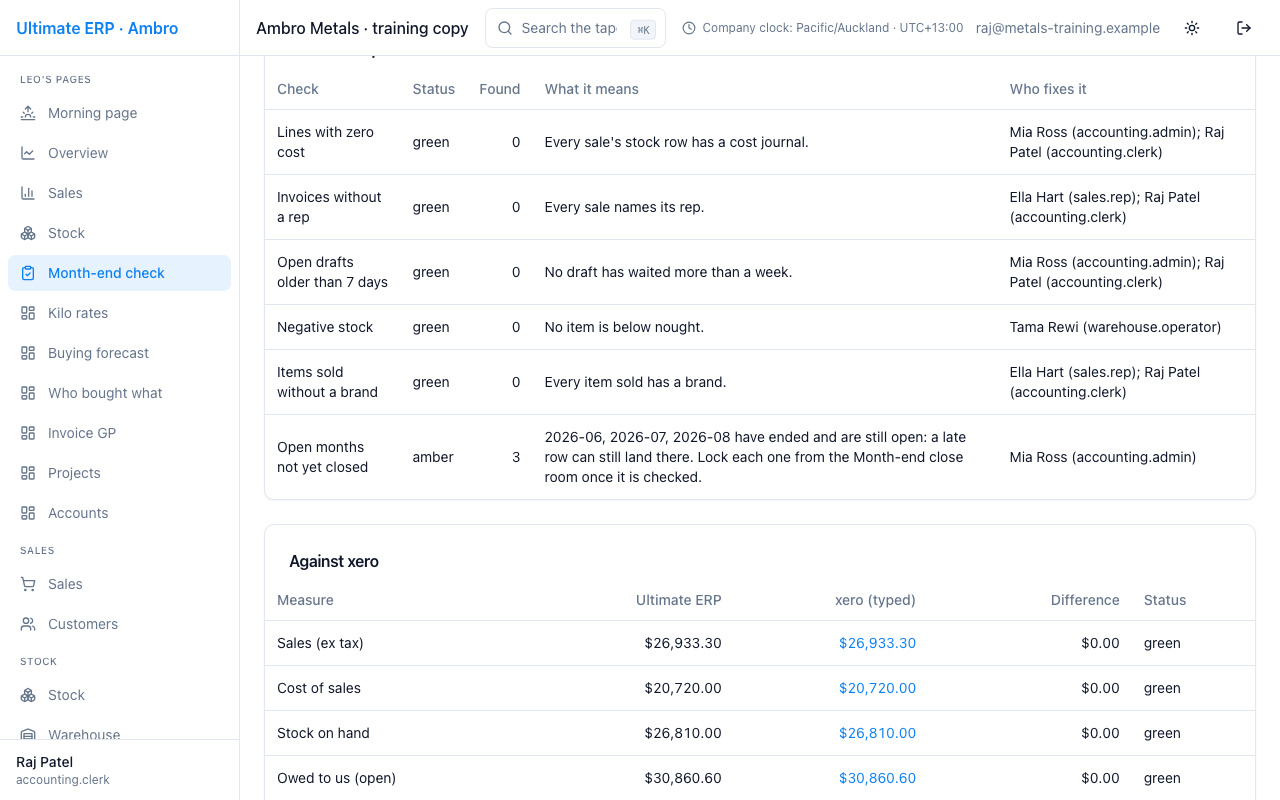
6.2 The month-end check8 min

The month-end check: the tape against Xero.
You should see: four green and one red, with the difference beside it.
Why it matters: the shadow is trusted when its numbers match Xero's, line by line.

6.3 Type last month's Xero figures, then a drill10 min

You should see: green rows for the figures that agree, and one red row naming the $100.
Why it matters: a figure that does not agree is found the day it is typed, not at year end.

6.4 Close the oldest month with two names12 min
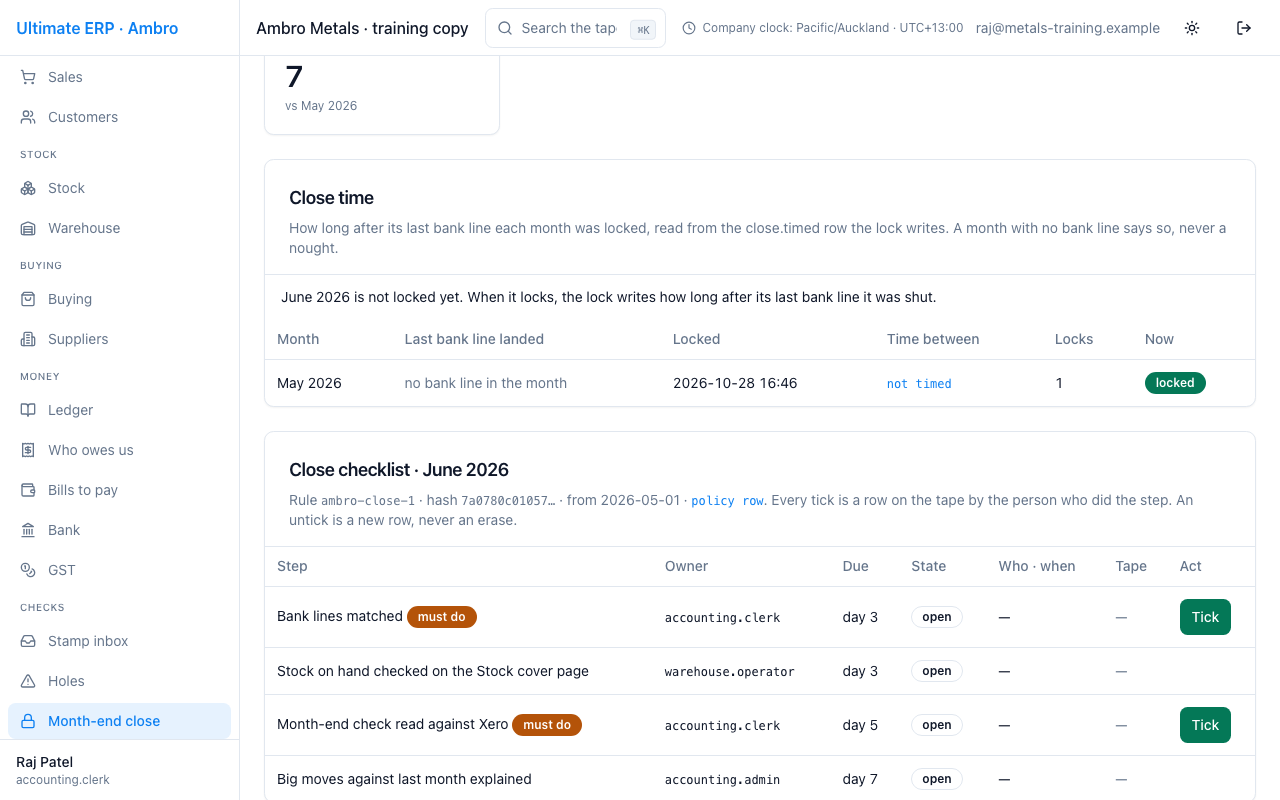
Month-end close: the checklist, prepare, review, lock.
You should see: the month says locked, with who prepared, who reviewed and when.
Why it matters: one person prepares and a different person reviews. Nobody closes their own month alone.

6.5 Drill: a late row in a locked month5 minrefusal drill

Do the wrong thing on purpose. Read the refusal, and write down the words it used.

You should see: the count refused by name, and nothing landed.
Why it matters: a locked month stays the way it was signed. A late change goes in an open month, where everyone can see it.

Check yourself

What does it take to lock a month?
The bank matched, the checks read, one person prepares, a different person reviews, then the lock.
Why is We owe red against Xero?
Ambro's supplier bills live in Xero, not in this system.
Can a row land in a locked month?
No. It is refused by name.

If you forget everything else

Keep three things: every page is a print of one list (the tape), a refusal names its rule, and a second person stamps.